-
動態

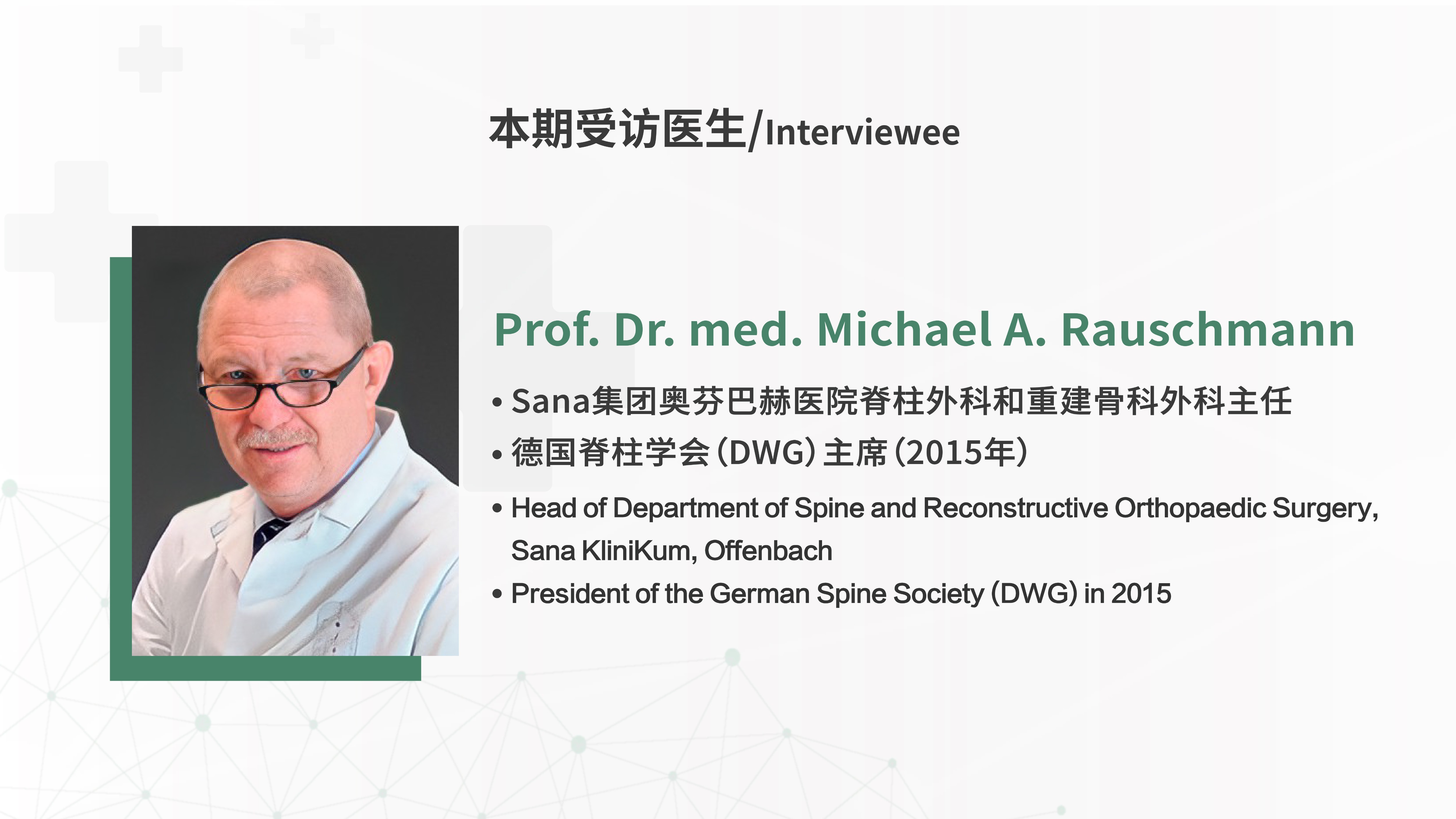
本期仁醫醫療特別邀請到國際著名脊柱專家Prof. Michael A. Rauschmann做專題訪問。Prof. Rauschmann現任Sana集團奧芬巴赫醫院脊柱外科和重建骨科外科主任、法蘭克福大學教授,他曾擔任德國脊柱學會(DWG)主席(2015年),連續11年獲得FOCUS頂級醫師獎(2012年-2022年)。2022年貴陽市第四人民醫院脊柱外科肖宇醫生將成為Prof. Rauschmann在中國的第一個臨床醫學博士(MD)。
Prof. Rauschmann編寫了《Spine Surgery》
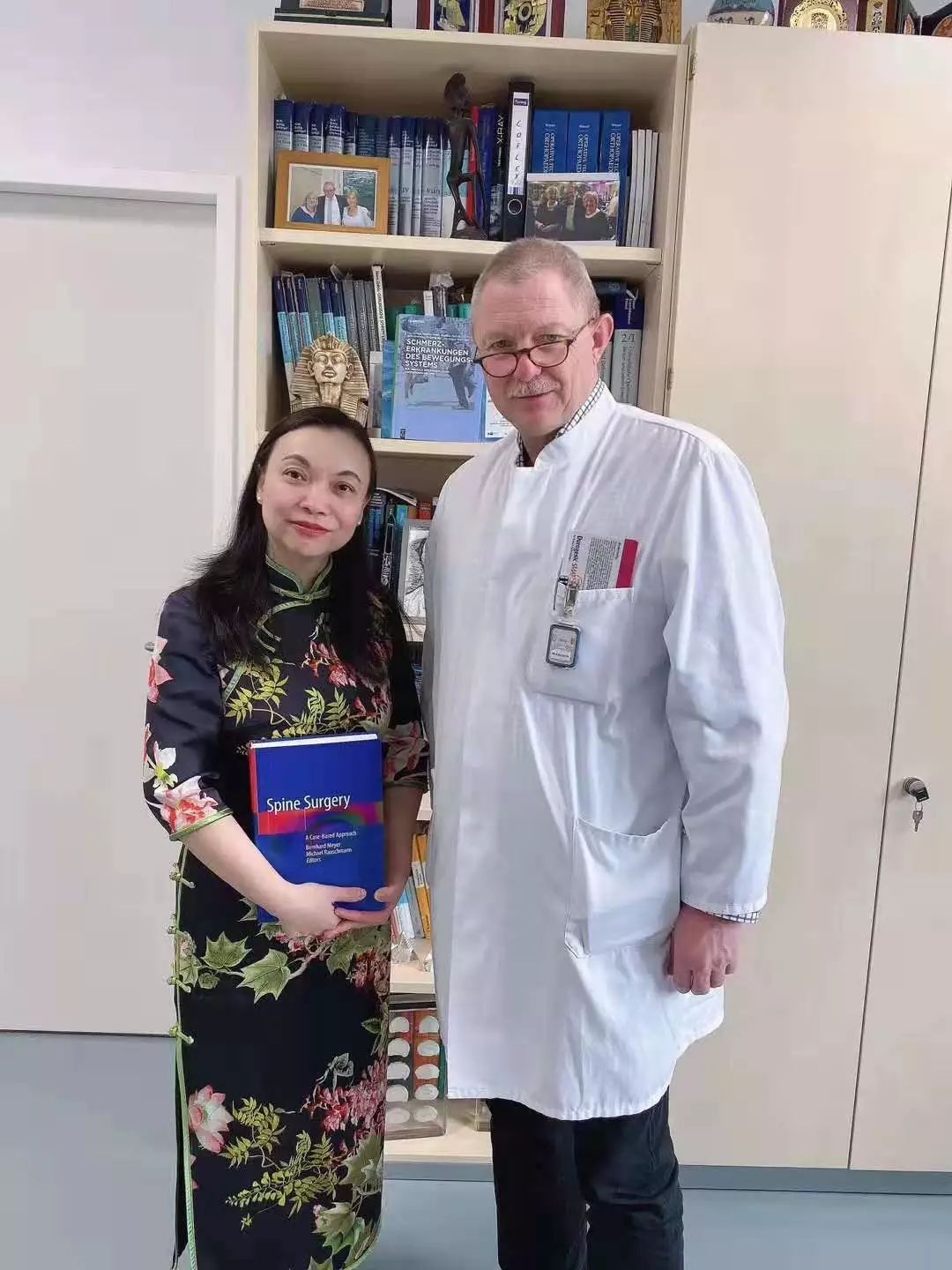
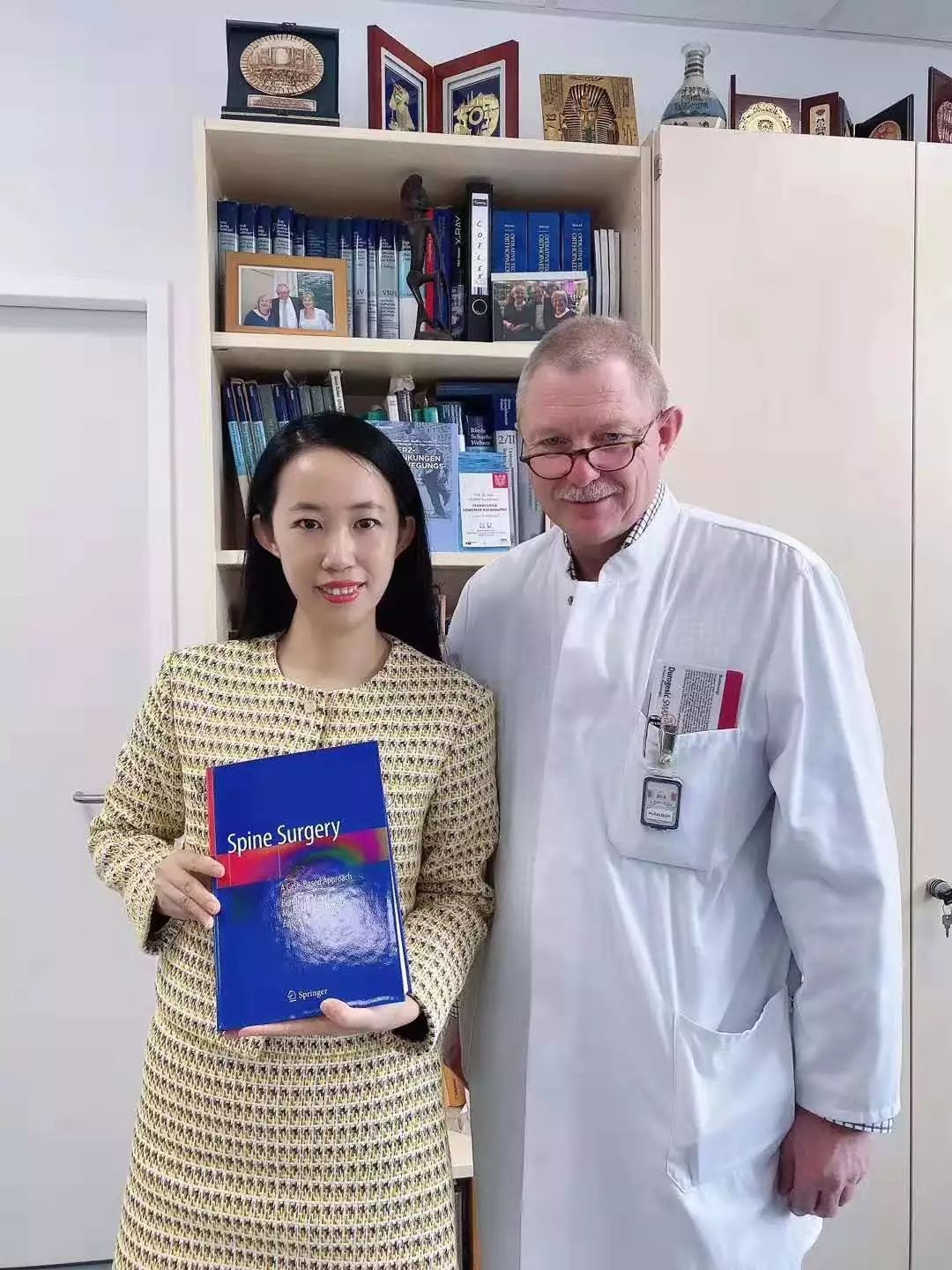
△Prof. Rauschmann贈與仁醫醫療團隊《Spine Surgery》
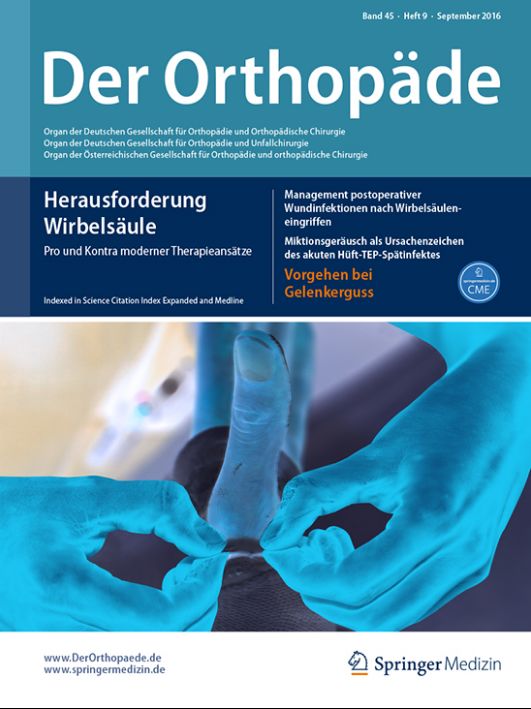
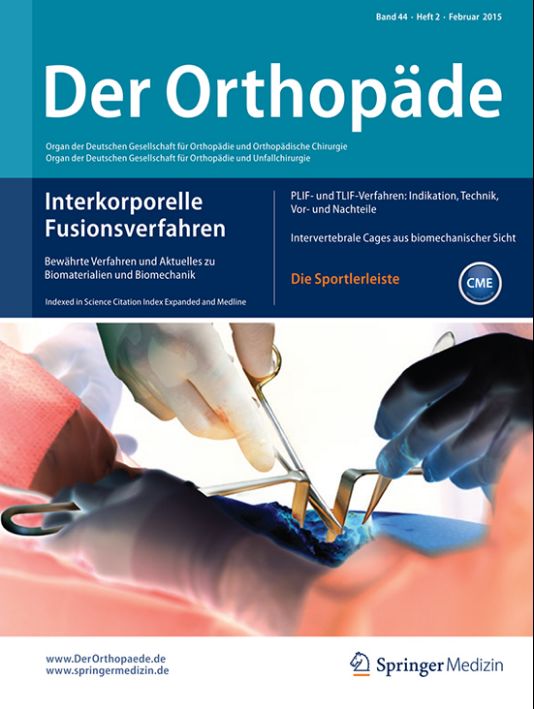
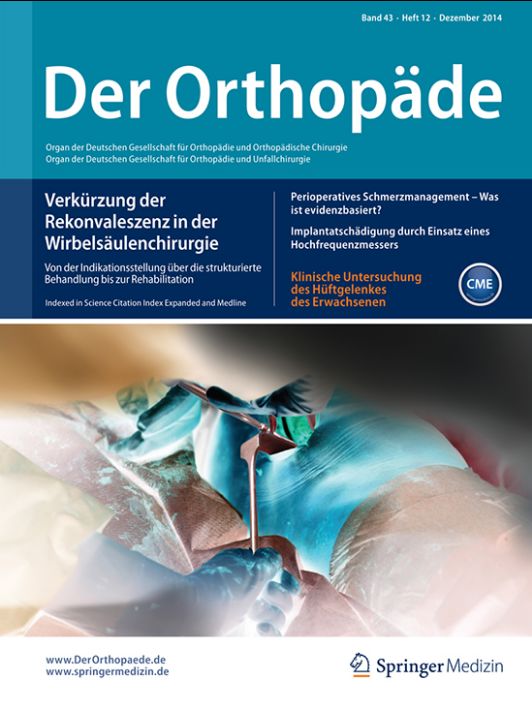
他還是Die Orthop?die《骨科》(原:Der Orthop?de)雜志專題發行負責人
精彩回顧
戳視頻 搶先看
1、您為什么學醫,又為什么決定專攻脊柱疾病呢?
Why did you decide to pursue a career in medicine and why, in particular, did you decide to specialize in the spine (or spine surgery)?
我一直都對大自然感興趣,在學校我最喜歡的科目是生物。作為一名學生,我在15歲的時候去了一家藥店實習,藥店的工作對于我來說過于理論化而實際問題較少,后來我就到了一家治療嚴重神經系統疾病的醫院實習,這也促使我下定決心學習醫學。
不過由于我的學習成績不夠,我暫時無法讀醫,所以我先去了德國軍隊服兵役,一年后我又去了學習汽車修理。完成汽車修理培訓后,我獲得了去匈牙利布達佩斯學習醫學的機會。兩個月后,我得到一個回德國法蘭克福學習的名額。所以我就回到了法蘭克福——我的出生地,并在此完成了我的學業。
我最感興趣的是解剖學。我和其中一位教授相處友好,他點名讓我學習顯微鏡切片制備,后來他還安排了一個實踐解剖學研究課題讓我準備論文。這很大程度影響了我學習外科專業的決定。后來我在德國的不同醫院接受實習培訓,我也去過奧地利、美國和南非的醫院實習了六個月。在這些實習經歷中,我總是喜歡在骨科手術室工作。完成醫學考試后,我開始了我的第一份工作,在一個創傷科室當醫生。兩年后,我轉到法蘭克福大學骨科醫院專攻骨科,我在那里至少呆了23年。
Thank you for the question. I always was interested in nature, in school my favorite subject was biology. So therefore first I did a practical training in a pharmacy as a student at the age of 15 years. This was for me too theoretical with less practical issues, so I did a practical training in a hospital for severe neurological diseases. This gave me the decision to study medicine. Due to my school grade, I was not able to start immediately with the medicine study, so I went at first to the German military and after one year I started an education as a car-mechanic. After finishing this education as a car-mechanic, I had the opportunity to start my medical studies in Budapest in Hungary and 2 month later I got a place in Frankfurt Germany, so I changed my study place and did my whole study in Frankfurt, here where I was born.
My favorite interest was anatomy. So I got a very intensive contact to one of my professors and he chose me to learn microscopic preparation and later he gave me a practical anatomical study to prepare my thesis, which I did. This influenced me very much in the decision to do a surgical subject in medicine. Then I did practical trainings in different hospitals here in Germany, I went to Austria, to the United States and to South Africa for six months. Here I always preferred to work in the orthopedic surgery units. After finishing my exams, I started my first work as a doctor in a trauma unit. Two years later I changed to the orthopedic university hospital in Frankfurt for specialization in orthopedics where I stayed at least 23 years.
2、在您的職業生涯中,是否有對您來說很重要的導師?他們教會您什么,是如何啟發您的呢?
Who have been you greatest influences? What have they taught you and how have they inspired you?
正如我之前提到的,對我影響最大的是我遇到的第一位教授,他是教解剖學的Oelschl?ger教授,他不僅給我安排畢業論文的研究課題,而且對我的科研基礎有著深刻影響。
后來當我在法蘭克福大學骨科醫院工作時,我遇到了兩位對我影響深遠的教授。一位是Ludwig Zichner教授,他是醫院院長也是一位骨科醫生,他影響著我的骨科科研工作,也激發我探索醫學歷史的興趣。對于我的臨床工作, 不得不提及Erich Schmitt教授,他是一名脊柱外科醫生也是脊柱外科主任。在他的影響之下,我完成了骨科學習后選擇了脊柱外科作為我的專業。
My greatest influence, as I mentioned before, was my first professor in anatomy, his name was Prof. Oelschl?ger, and he gave me my theme for the thesis and he really had a big influence, concerning the base of my scientific work. Later on, when I went to the orthopedic university hospital I had two professors, the chair of the hospital was Prof. Ludwig Zichner, he was the general orthopedic surgeon and he influenced me due to my scientific orthopedic work and my interest in history of medicine. And concerning my clinical work, Prof. Erich Schmitt, he was the spine surgeon and he was running the spine unit, and he influenced me doing spine surgery as my specialization after finishing the education in orthopedics.
3、作為大學教授、科室主任、眾多學會成員,您是如何平衡行政、臨床、科研工作、教學以及個人生活?
As a university professor, chief physician, members of many professional societies, how do you balance the administration, clinical practice, research activities, teaching and personal life?
首先,在我心目中,家庭是排第一位,其次是我的臨床工作,但實際上,毫無疑問我的臨床工作以及科研工作占據了我生活中的大部分時間。我非常喜歡教學工作,無論對象是學生還是醫生,所以我在德國脊柱學會(DWG)非常活躍。我是DWG學院的執行董事,負責學會所有證書的教學課程。
First of all, in my mind, the family is the first choice and secondary of course, my clinical work, but in reality concerning my time, I would say of course the clinic and my clinical work and my scientific work takes most of the time in my life. Teaching students and doctors in education I like very much. Therefore I’m very active in the German Spine Society (DWG). I’m the executive director of the academy of the DWG and responsible for all the educational courses for our certificates.
4、作為眾多醫學學會的成員,您參加過許多國內外的學術活動,這對您的職業生涯有何幫助?
You have been an active member of a number of medical organizations, and have been engaging in many regional and international academic activities, how has this helped to shape your career?
參加各種大會或研討會有助于增進與脊柱外科領域的意見領袖和重要人物的聯系,我也得到與他們第一次接觸的機會。通過展示我的成果,我獲得了尊重并被邀請負責德國脊柱學會的教學課程工作。我投入了大量精力,因此在2015年德國脊柱學會董事會選舉我擔任主席。這些經歷對我職業生涯的影響是深遠的。
Going to congresses and workshops helps a lot to get in contact with opinion-leaders and important persons in the field of spine surgery. This helped me a lot to get my first contacts. By showing my results, I got respect and was asked to support these courses in the German Spine Society. I committed myself intensively and so the board of the German Spine Society elected me in 2015 to be the president of the German Spine Society. All this together shaped my career in a very important way.
5、在2017年,您離開法蘭克福到Sana集團奧芬巴赫醫院就職,并在該院擔任脊柱外科和重建骨科外科主任至今,能否分享一下當時過渡期間,您遇到最大的挑戰是什么?
In 2017, you moved to the Sana Clinic in Offenbach from Frankfurt, and since then you have been the head of the Department of Spine and Reconstructive Orthopaedic Surgery there. Could you please share with us what was the biggest challenge you encountered during the time of transition?
在過渡期間,我遇到了許多挑戰。
首先,我會擔心病人會不會追隨我。因為如果沒有病人,醫生就無事可做。其次,醫院的醫生和教授對我的態度是怎么樣的呢?護士和行政部門是否會接受我以及如何配合我的工作?第三,我在新的環境中是否會感到快樂?
我認為最后一點非常重要,如果你在一個地方工作不開心,你就無法發揮你最大的能力。我真的很高興他們能接受我,接受我的工作方式以及我所做的工作。不久后,我就與醫院的各個學科建立了聯系。Sana集團奧芬巴赫醫院是一家大型醫院,擁有上千張床位。這家醫院的一大優點是各個科室和學科的工作配合緊密,我也很快適應了新環境。我很榮幸能成為這個由20多個學科組成的團隊中的一員。我們以完美、專業的工作方式來共同幫助我們的病人。這對我來說是最重要的事情,我可以按照我喜歡的方式來完成我的工作。
There were a lot of challenges by doing this transfer. First of all, I was scared if the patients will follow me, because if you do not have patients, you do not have something to work. The second was how will the doctors in the hospital and the professors react to me? How will the nurses and the administration will work with me and accept me in my work? And third, will I be happy in a new environment?
I think the last point is very important, if you are not happy in the place where you work, you cannot give your maximum power. Therefore I was really glad that they accepted me, that they accepted the way how I work and also accepted my work which I do. It took not a long time until I got in contact with all the different disciplines. The Sana Clinic Offenbach is a very big institution with thousand beds. And a big advantage is that all these institutions and disciplines work very close together and that worked out for me also quite fast, so I'm really happy to be a member of this team of more than 20 disciplines in the house and we work in a very perfect way, a very professional way, together to help our patients. So this is for my side, the most important thing, that I can do my work how I like to do it.
6、Sana集團奧芬巴赫醫院大骨科有分科嗎?
Are there any orthopedic sub-specialties in the Sana Clinic Offenbach?
奧芬巴赫醫院大骨科有不同的亞專科。我們有一個髖膝關節假體置換中心,還有一個與整形外科醫生團隊組成的卓越燒傷中心,它不僅服務于當地區域。我們還有一個足踝中心,與兒科合作治療足部和小腿的畸形。我們醫院的創傷救治工作也非常優秀,由于這是一家位于大城市的大型醫院,我們配有直升機以及3組創傷急救人員專門接收和運送病人。因此我們的創傷中心是非常大型的,每年救治成千上萬的病人。
There are different sub-specialization, we have a sub-unit for endoprosthesis of hip and knee and we have a burning unit together with plastic surgeons which is a very exceptional and is not working only for our region. And we have a special unit for foot and ankle and we also work with a pediatric department concerning deformities in the foot and lower leg. And of course the trauma work is very exceptional, because it's a big hospital in a very big area, so we have the helicopter, we have three emergency units who go out and bring the patients in. So it's very big with thousands of patients every year.
7、您科室每年做多少臺手術?
How many surgeries are performed in your department every year?
就目前來說,每年大約有800臺手術。但我要補充一點,這些手術大多數都是大手術,完成一臺腫瘤切除術或手術處理脊柱椎間盤炎通常耗時許久,所以外科醫生不可能在一天內完成太多手術。但現實是我們每天24小時都接收很多急診病人,因此我們的手術量不會少。而且科室每天會開放兩間手術室,一間用于做大型的、耗時長的手術,而另外一間用于做各類小型手術,如髓核切除術、減壓術等。
Nowadays I would say around 800 surgeries. You must take in mind that a majority of these surgeries are always big surgeries, so if you do a tumor surgery or a surgery in spondylodiscitis, that takes typically many hours of the day, you cannot do so much more on one day. But due to the fact that we have also a lot of emergency cases which are running 24/7. This makes the high number and also we are running two OR rooms every day. Here we have one room where we do the big surgeries, the long surgeries, and in the second room, we do more the smaller ones like nucleotomies and decompressions or something like that.
8、能否分享一下您治療過的最具挑戰性且最印象深刻的病例?
Could you please share one case that you think is the most challenging and impressive one?
從醫多年以來,我遇到過許多不同且極具挑戰性的病例,當中有寶貴的經驗也有失敗的教訓。我記得我曾經做過一臺上胸椎大腫瘤切除手術,是由潘科斯特腫瘤(Pancoast tumor)引起的。我花了至少12小時來操作這臺手術,然后胸外科醫生才把腫瘤連同肺部一起切除,這是一臺非常具有挑戰性的手術。
還有切除骶骨上的脊索瘤這類手術,對我來說也是非常有挑戰性的。我們希望在不觸及腫瘤的情況下進行廣泛性切除,這就導致手術耗時非常長。同時骶骨是一個非常脆弱的部位,進行這類手術對病人也會有嚴重的影響。
當然,在我的腦海中,我仍然記得有一個“死在手術臺上”(Mors in Tabula)的病例,是一個患有嚴重的多節段腰椎間盤炎的病人,在手術最后因心臟病發作而死亡。當時我承受了很大的壓力,因為我不清楚病人猝死的原因是什么。直到最后,對病人進行病理調查后,我們才發現這不是外科醫生的過失,而是由于病人心臟病發作才導致死亡。這給我留下了深刻的印象,至今我仍會想起我生命中那黑暗的一天。
During all these years I had different cases in my life which were very challenging for me, on the one hand of course pearls, but also pitfalls, so I remember a big tumor resection in the upper thoracic spine by a so-called Pancoast tumor, so that took at least a surgery time for me of 12 hours and then the thoracic surgeon had to take away the tumor in combination with the lung, so this was a very challenging surgery.
And also different surgeries on Chordomas in the sacrum where were very challenging for me. It’s a very long surgery where we want to get a wide resection without touching the tumor. This is a very delicate region, also there are severe consequences for the patient.
And of course in my mind, there is still a so-called “mors in tabula” where a patient with a severe spondylodiscitis in different segments of the lumber spine died in the last part of the surgery due to a heart attack. So this for me was a big stress because I didn't know what was the reason for this sudden death. And only at the very end when the patient was investigated by the pathology, we found out, that this was not the fault of the surgeon and this was a heart attack, but this impressed me very much and I nowadays still think about this very bad day in my life.
9、法蘭克福市因您在醫學領域享有盛譽而任命您為該市“大會大使”,這對您來說意味著什么?
The city of Frankfurt am Main has appointed you as one of its congress ambassadors because of your reputation in medicine, what does this appointment mean to you?
我很榮幸能成為法蘭克福市的“大會大使”當中的一員。這要歸功于2015年舉辦的德國脊柱學會年會。這場大型盛會匯聚了2750名參會者,這對于法蘭克福市,特別是對于會務中心及其周圍的酒店和餐館來說是一場大型商業活動。當然邀請國內外嘉賓參加這場盛會,對我們的城市來說也是一種榮譽,我也很高興能成為大會大使中的一員。現在我們仍在推動著這些活動,我會組織各類學術座談會和研討會,邀請來自世界各地的醫生參觀我們在醫院的工作情況。他們還可以游覽城市,法蘭克福市也因這些嘉賓的到來而增色添彩。它是一座非常漂亮的城市,人們稱它為美因哈頓(Mainhattan),因為這里的摩天大樓在德國是獨一無二的。
It was an honor for me, belonging to the group of ambassadors of our city here in Frankfurt, this was due to the congress in 2015. For the city, such a big congress means, that we had 2750 participants at the congress which is a big business for the city of course, especially for the convention center, for the hotels around the convention center, and for the restaurants in the city. And having national and international guests for such a congress, it is also an honor for our city and therefore I'm happy to be one of the ambassadors. And still nowadays, we continue with this program and I do further symposiums and seminars where doctors from all over the world come to visit me and to see me how we work in the hospital. They all get contact with the city and get a walk around with me, and so also Frankfurt has a profit of guest doctors because Frankfurt is a very nice city, you know they call it Mainhattan because of the skyscrapers which is exceptional here in Germany.
10、至今您最自豪的職業成就是什么,為什么?
What is your proudest career achievement to date and why?
每天都有我成功治療的病人,他們對我的工作表示非常感謝,這是我最自豪的職業成就。此外,如之前提及,我擔任過德國脊柱學會的主席。我能在德國乃至國際著名的脊柱外科醫生當中脫穎而出當選主席,對于我來說是一個極大的榮譽。當然最重要的是我的病人,我工作中最大的成就是,病人術后能感到開心和滿意。
Everyday the patients which I have successfully treated and who are very thankful to my work, this is the proudest career achievement for me. Furthermore the presidency of the DWG which I mentioned already, because I was elected from a board who are the most important spine surgeons in Germany but also international. This was a very big honor for me. But on the first place, I still see the patients and this is my biggest achievement in my work having happy and satisfied patients after my surgical work.
11、您對想要開啟他們的脊柱外科生涯的年輕醫生有什么建議?
What advice would you give to young surgeons hoping to start a career in spine surgery?
第一,我建議他們先在普外科學起,或者在一家醫院全面地學習普外科、血管外科和創傷外科的知識。
第二,花時間認真處理每一個病例,陪伴病人。你要學習治療的方法,從診斷、手術切口的制作、手術適應癥、跟進手術過程以及手術成功的原因,還有病人的愈合過程和長期療效。還有一點很重要,當病人向你尋求進一步意見時,你要清楚能為病人提供什么建議,是做手術還是采取保守治療等等。
第三,永遠都要制定一個B計劃。你的第一個治療方案不一定能通過做手術實現,尤其是在脊柱外科手術中,所以一定要考慮,如果第一個治療方案失敗了,下一步該做什么。
第四,永遠不要違背病人的意愿進行治療。如果沒有獲得病人的信任就不能治療,也不能給他做手術。治療病人的前提是,病人必須接納你的治療方案,以及信任你作為他的外科醫生。
第五,觀察的病人癥狀,始終對你的診斷持保留意見,并且要相信病人。當病人說:“我對手術不滿意,我還有疼痛、麻痹或者癱瘓的癥狀”。認真對待病人說的話,當作事實并試著去驗證它,通常都能找出原因。病人是從不說謊的。而且重要的是,你要清楚即使你堅信你所做的手術是完美的,也可能發生一些意外,從而導致手術不成功。
第六,手術前與病人會面,這點在病人的康復過程中也非常重要。讓病人知道你和他們待一起,照顧著他們。這樣在病人麻醉前的最后一刻,你都可以掌握他們的真實癥狀。因為有時病人的癥狀會改變,有時右腿的癥狀已經沒有了,而表現在左腿、右臂或者左臂。所以手術前與病人會面,獲得病人最新的情況非常重要。
第七,對病人要誠實。即使你出現了失誤,也要告訴病人發生了什么,并解釋為什么會發生這種情況。病人可能會同意再做一次翻修手術。對病人要誠實,不要對他們有隱瞞。
以上是我對年輕外科醫生的建議。
I would always say they should start in a general surgery unit or in a hospital where they get a broad education in general and vascular surgery but also in trauma surgery.
Take the time for every case and stay with the patients. That's very important that you learn the way of the treatment starting with the diagnosis, doing the incision making and indication for the surgery, following the surgery and following the success of the surgery, the healing process, but also the longtime results of these patients. That's important to have an idea what you recommend to the patients later on, when you have to give them your opinion what they should do, if they should do a surgery or conservative treatment or whatever.
Try always to have a plan B for a treatment, especially in spine surgery not always your first plan will be realized in the OR, so you have to have an idea what you have to do if your first idea, if your first plan will fail.
Never do a treatment against the conviction of the patient. If the patient is not convinced, don't treat him, don't do the surgery. Patients have to be convinced of the treatment method which you will do and they have to be convinced of you as the surgeon.
Be always critical to the prescriptions from symptoms to the patients and believe them, so when a patient says, “I'm not happy with the surgery, I still have pain or I have numbness or I have a paralysis”. Take that as a truth and try to proof it, very often you will find a reason. And patients never lie, that's important to know that even if you are convinced that your surgery which you have done was perfect, even then, something can happen and can lead to an unsuccessful problem.
Try always to see a patient before doing a surgery. That's very important, also for the healing process after patients, that they know you're with them, you take care of them and you have in the very last step before the patients get the narcosis, you have another idea of their real symptoms, sometimes they change, sometimes it's not anymore on the right leg, it's now on the left leg or on the right arm, on the left arm, so it's important to see the patients just before the surgery to get all these new information about them.
At the end of the day, be honest to the patients. Even if you make a mistake, tell the patients what happened and explain them why that happened and then they still go with you also this hard way of revision surgery if this is possible, but be honest to them and don't lie to the patients.
These are my advice for young surgeons.
12、能和我們說說脊柱外科手術未來發展趨勢?
What’s the future trends of spine surgery?
脊柱外科手術的發展前景十分光明。因為脊柱手術與髖膝關節置換術相比,前者還有許多待發掘的空間。我相信未來幾年機器人導航和新的手術技術會如春筍般涌現出來,未來的脊柱外科手術會更加蓬勃發展。所以我堅信脊柱外科手術在外科領域的發展道路會變得更加廣闊,導航和機器人技術也會讓這類手術技術變得更加精確。
外科醫生的手感永遠是重要的,手術的成功不能僅依靠機器人和導航裝置。手感、治療計劃的制定以及正確的手術指征判斷都是需要外科醫生來決定,而不是由計算機來決定。因此我們必須記住醫生的手術技能和手感才是脊柱外科手術獲得成功最關鍵、最重要的因素。當然所有的這些技術裝置是能輔助外科醫生、提高手術成功率,還有提高手術精確度,可能也會增加或縮短未來的手術時間。
There will be a great future concerning spine surgery because if you compare spine surgery with endoprosthesis in hips and knees, we are far away from the discovery, so I think navigation robotics and new surgical techniques will come over during the next years and they will increase even more in the field of spine surgery in comparison to today. So I'm very convinced that spine surgery will get bigger in the field of the surgical disciplines and also the techniques will get more precise concerning navigation and robotics. But still the feeling of the surgeon will always be important, a robot and a navigation unit cannot be only responsible for the success of the surgery, still the fingers, and the therapeutic plan which is done by the surgeon itself, making the right indication is still in the hand of the surgeon and not in the hand of a computer. So this is what we still have to take in mind that our handwork and our feeling in doing such a surgery is still the biggest, important thing to have success. But all these technical things, they will support us and they will increase our success and will increase our precision doing it and probably it will also increase or shorten the time of surgery in the future.
13、假如您不從醫的話,您會從事什么行業?
What would you have been if you had not been a medical doctor?
如果我沒有機會學習醫學,我不知道我的未來會如何,但正如我在采訪初始時提到的,我的家人是從事技術勞動工作的。我父親有一家汽車噴漆公司,我曾經也學過汽車修理,所以假如我沒有學醫,我可能會接管我父親的生意,繼續經營他的汽車噴漆公司,這可能就是所謂的B計劃。但其實我不想學習其他東西,我只對醫學感興趣。
I don't know exactly what will have happened, if I would not have got the opportunity to study medicine, but as I mentioned at the very beginning of our interview, you know, I'm coming out of a family of hand workers. My father has had a car painting company and I was educated as a car mechanic, so probably I would have taken over his business and would have continued with the car company, that would have been probably the so-called plan B if I would not have had the chance to study medicine. I didn't want to study anything else, I only was interested in medicine as a study.
14、除了學醫外,您還有什么興趣愛好?
What are your interests and hobbies outside medicine?
我喜愛大自然,所以我的愛好都與大自然有關。我喜歡養蜂、打獵,也喜歡劃著獨木舟或乘坐摩托艇在水上航行。每個暑假我們都會去海邊乘船游覽,這是讓我非常享受的愛好。我還喜歡騎自行車,喜歡待在我的花園里觀賞花卉植物。每年我都會購買一些新植物,增添我花園里的植物,看著它們如何生長開花。
I love the nature, therefore all my hobbies have something to do with nature. I'm a beekeeper, I like to go hunting, but I also like to go on the water either with my wooden canoe or with my motorboat. In every summer holidays, we go to the sea with our boat and do day cruises, so this is what I like very much. Also I like cycling and I like to go in my garden and look to the plants, and buy new plants every year to increase the number of plants in my garden and see how they grow and how they flower.